Nano-encapsulation Technology
Improving the delivery, stability, and functional performance of natural bioactive compounds through structured nano-encapsulation systems.
The Delivery Challenge in Natural Bioactives
Natural bioactive compounds can offer significant functional potential, but they are often difficult to deliver in a form that remains stable and predictable. Many plant-derived compounds are sensitive to environmental factors such as oxygen, light, heat, or changes in pH, and can degrade long before they reach their intended use.
Dispersion is another common challenge. A large proportion of natural compounds are poorly compatible with water-based systems and may clump, separate, or remain unevenly distributed within a formulation. This can affect consistency, reliability, and overall performance.
As a result, the quantity of an ingredient included in a formulation is only part of the equation. How a compound is protected, stabilised, and presented within a system plays a central role in determining whether it can function as intended.
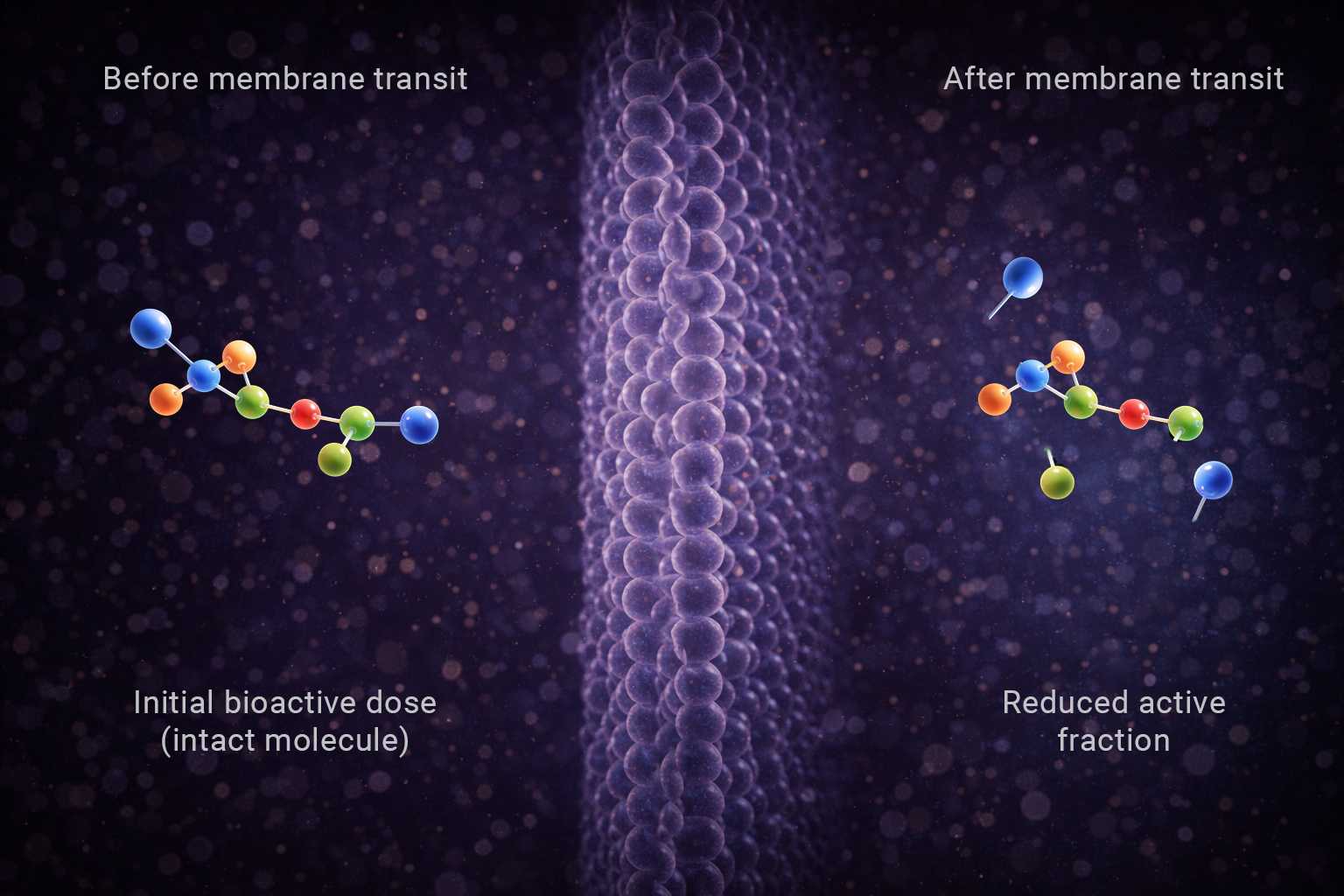
Unprotected bioactives often lose structural integrity during membrane transit, reducing the fraction of intact active available for absorption.
Why Traditional Formulation Falls Short
Conventional formulation techniques can improve the appearance, texture, or shelf life of a product, but they do not always address the underlying challenges of delivery and stability. In many cases, bioactive compounds are added as powders or extracts that remain vulnerable to degradation throughout processing, storage, and use.
Methods such as simple emulsions or suspensions may help ingredients coexist within a formulation, but they often provide limited protection for sensitive compounds. Over time, separation, settling, or loss of functional integrity can occur, leading to inconsistent performance.
Another common approach is to increase ingredient concentration to compensate for degradation or poor dispersion. While this can appear effective in the short term, it may introduce additional complexity around taste, texture, irritation potential, or cost, without resolving the fundamental limitations of delivery.
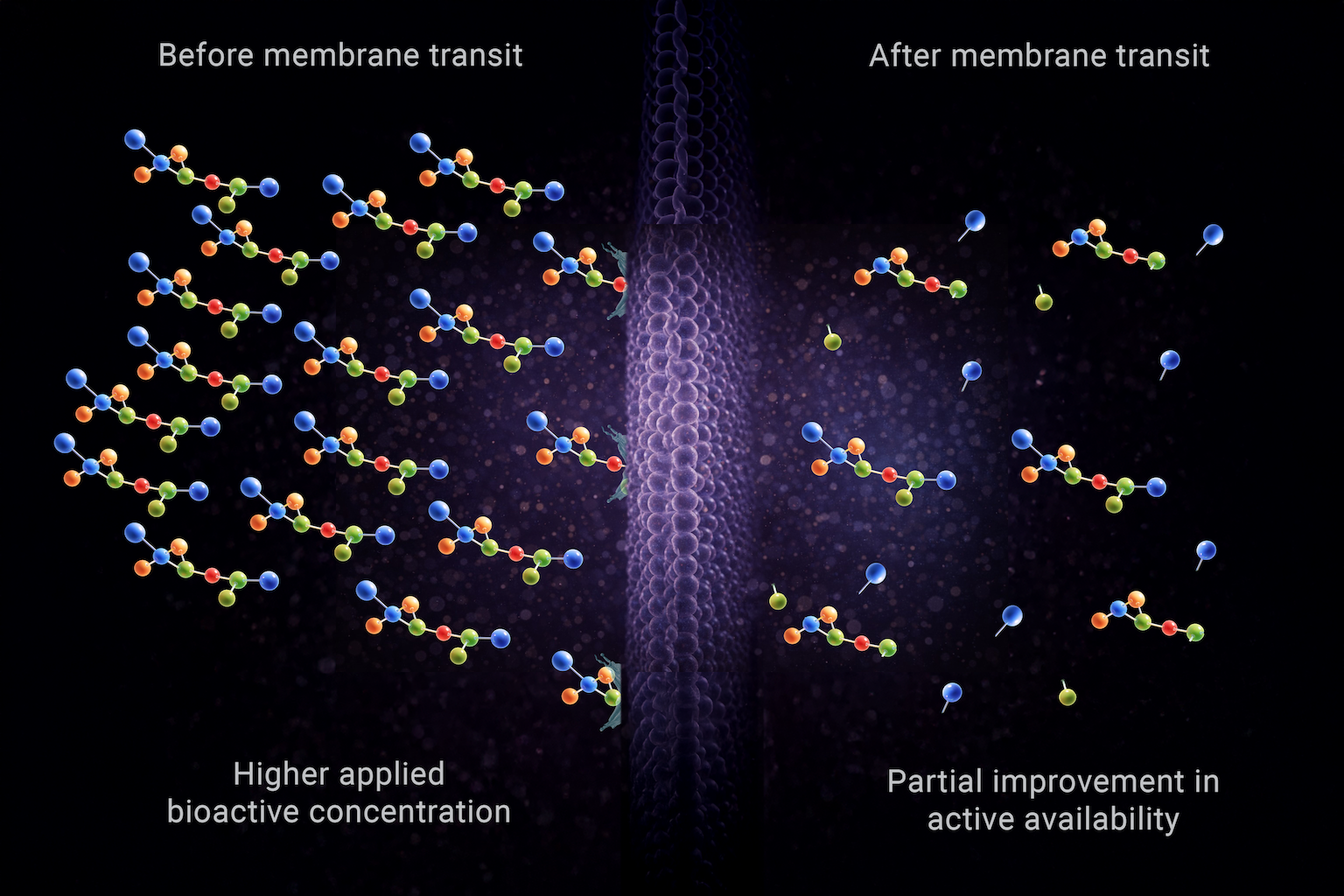
Increasing applied dose can partially compensate for loss, but does not address the underlying instability of unprotected bioactives.
How Nano-encapsulation Changes the Equation
Nano-encapsulation addresses the core limitations of traditional formulation by surrounding sensitive bioactive compounds with a protective carrier at the nanoscale. This structured encapsulation helps shield ingredients from environmental stressors such as oxygen, light, heat, and pH variation, improving stability throughout processing, storage, and use.
Beyond protection, nano-encapsulation improves how bioactives are presented within a formulation. Encapsulated compounds can be more evenly dispersed in water-based or mixed systems, reducing separation and inconsistency. This leads to more predictable performance and a more uniform experience across each application or dose.
By controlling both protection and dispersion, nano-encapsulation allows bioactive compounds to function closer to their intended potential. Rather than compensating for degradation or instability through higher concentrations, formulations can focus on efficiency, balance, and reliability.
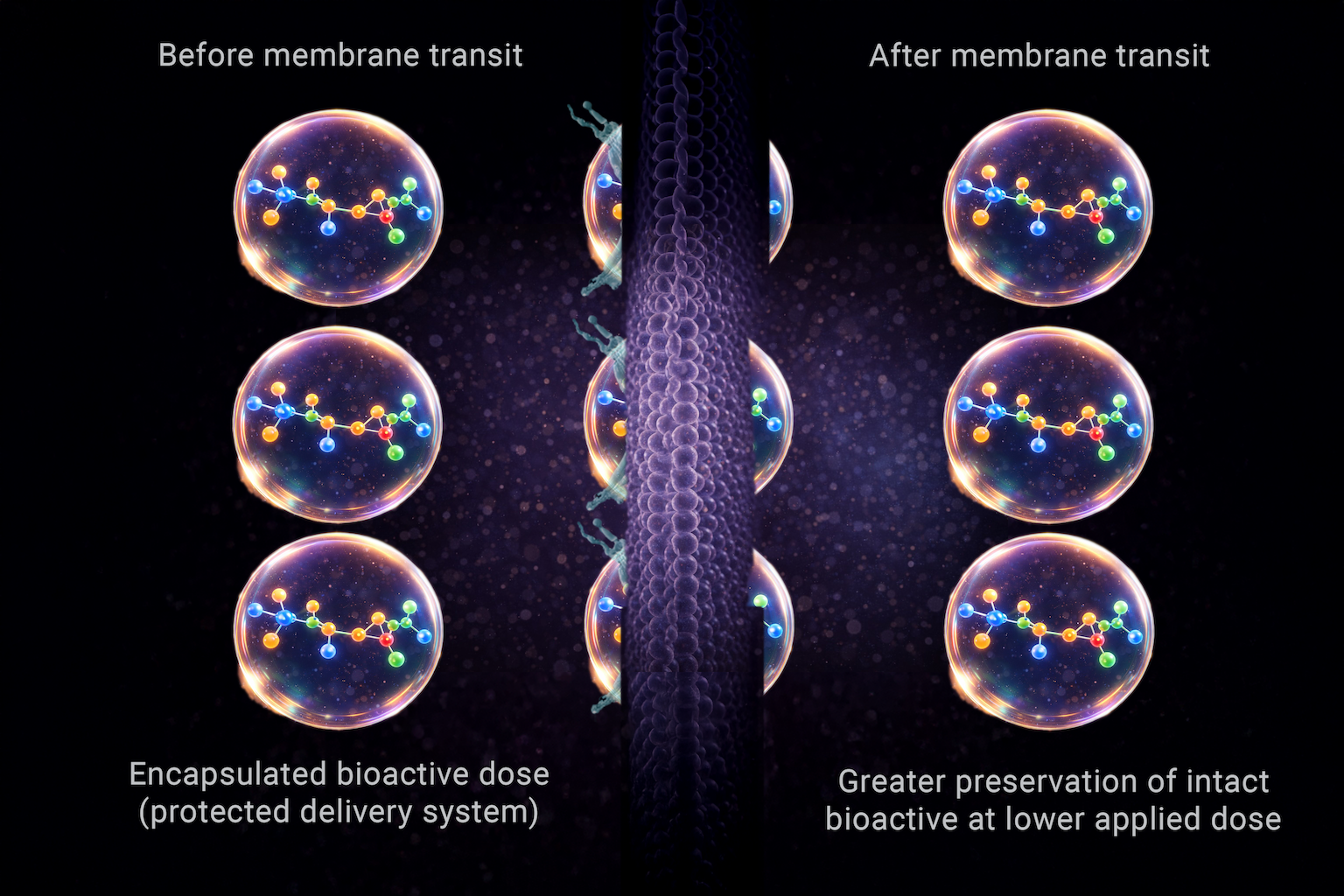
Nano-encapsulation preserves bioactive integrity during membrane transit, enabling higher effective availability at lower applied doses.
A Controlled, Scalable Encapsulation System
Nano Botanicals’ nano-encapsulation approach is designed as a delivery framework rather than a single fixed formulation. This allows encapsulation parameters to be tuned based on the characteristics of each bioactive compound, including sensitivity, solubility, and intended application.
By adjusting factors such as carrier composition, particle size range, and release behaviour, formulations can be optimised for stability, dispersion, and functional performance without relying on excessive ingredient loading or aggressive processing techniques.
Importantly, this framework is built with manufacturability in mind. Processes are designed to be repeatable and scalable, supporting consistent outcomes from laboratory development through to commercial production. This ensures that performance characteristics observed during formulation development can be maintained as products move into wider distribution.
Practical Benefits Across Product Categories
The value of nano-encapsulation lies not only in improved stability, but in the practical benefits it enables across different product formats and use cases. By improving dispersion and protecting sensitive compounds, formulations can achieve more consistent performance without relying on high concentrations or heavy formulation aids.
In topical applications, this can support smoother textures, improved uniformity, and greater formulation stability over time. In ingestible or functional formats, enhanced dispersion and protection can help maintain ingredient integrity throughout processing and storage.
Because the encapsulation technology is adaptable, it can be applied across a wide range of natural bioactives and product categories. This flexibility allows Nano Botanicals to develop solutions that are tailored to specific functional goals while maintaining a consistent underlying delivery architecture.
From Laboratory Innovation to Manufacturable Products
Nano Botanicals’ technology is designed with manufacturability in mind from the outset. While many delivery innovations remain confined to laboratory settings, our approach focuses on systems that can be scaled, reproduced, and integrated into real production environments.
Encapsulation structures are engineered to remain stable through common formulation, filling, and storage conditions, supporting consistency across batches and over time. This enables product development teams to move from concept to commercial production without fundamentally redesigning the delivery system at each stage.
By aligning scientific design with practical manufacturing requirements, Nano Botanicals develops encapsulation technology that supports innovation without compromising reliability.